My Story My Question Book: Where Curiosity Meets Confidence in Early Learning
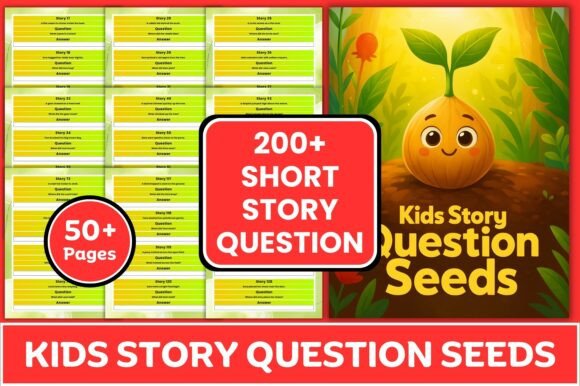
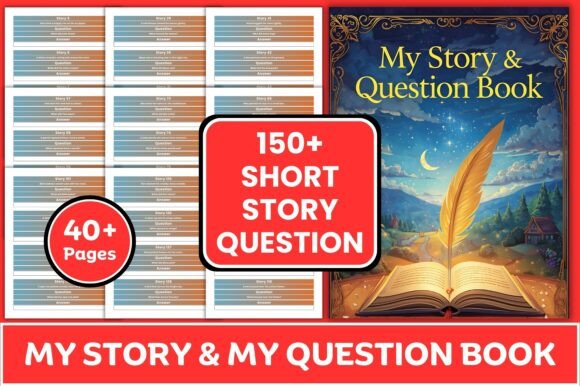
If you’ve ever watched a child pause mid-sentence to ask, “But why did she do that?”—or seen their face light up when they correctly recall a character’s name after hearing a story just once—you already know how powerful simple questions can be. My Story My Question Book isn’t another dense workbook filled with abstract exercises. It’s 40 pages of quiet magic: 150 bite-sized stories, each followed by one thoughtful, age-appropriate question—designed to meet young readers exactly where they are.
Real Life, Real Moments: Where This Book Fits In
Think about the moments that matter most—not the ones we plan for, but the ones that happen:
- A kindergarten teacher finishing morning circle—she pulls out My Story My Question Book for five minutes of shared reading and quick verbal responses. No prep. No laminating. Just open, read aloud, point, and listen. Children who rarely raise their hands begin volunteering answers because the questions feel safe, familiar, and doable.
- A parent juggling bedtime routines—they choose one story instead of scrolling through apps. Two minutes of reading, one question asked over toothbrushing (“What did the squirrel forget?”), and a giggle when their child points to the picture and says, “His hat!” That tiny exchange builds memory, vocabulary, and connection—all without pressure.
- A homeschooling caregiver with two kids at different levels—they use the same page: the younger one points to pictures and names characters; the older one writes a full sentence in the answer space. The clean layout makes differentiation effortless—not an add-on, but built-in.
- A reading interventionist supporting English language learners—they print single pages and use them during small-group work. The predictable rhythm (story → question → space to respond) reduces cognitive load. Kids aren’t decoding instructions—they’re focusing on meaning. And because every story is under 60 words, comprehension feels achievable, not overwhelming.
Who Benefits—and How It Shows Up Differently
The beauty of My Story My Question Book is how it adapts—not because it tries to be everything, but because its structure honors how learning actually happens across contexts.
For classroom teachers: It works as a warm-up, a transition tool, or a low-stakes exit ticket. One first-grade teacher told us she uses it during “quiet choice time”—students pick a story, read independently (or with a buddy), answer the question, and draw a quick picture beside it. She collects them weekly—not to grade, but to notice patterns: Who’s grasping cause-and-effect? Who needs more support with sequencing? The data isn’t in a spreadsheet—it’s in the margins of real work.
For tutors and after-school providers: It removes guesswork. Instead of spending 20 minutes designing a custom comprehension prompt, they open the book, flip to page 17, and start. The consistent format means students quickly internalize expectations—less time explaining “what to do,” more time doing the thinking.
For families navigating learning differences: The one-question-per-story design prevents overwhelm. A child with attention challenges doesn’t face a wall of text or multiple-choice options. They hear or read a short narrative, focus on *one* idea (“Where did the dog hide?”), and respond in whatever way fits *them*—verbally, pointing, writing one word, or even acting it out. That flexibility isn’t accommodation—it’s respect for how their brain engages.
Practical Considerations Before You Begin
While My Story My Question Book is intentionally simple, getting the most from it involves noticing a few quiet details:
- It’s not meant to replace rich storytelling—but to deepen it. Use it alongside read-alouds, picture books, and conversations. Its strength lies in repetition and routine—not isolation.
- The “one question” rule is intentional. Too many prompts dilute focus. One well-placed question invites reflection without fatigue. If a child wants to talk more? Absolutely encourage it—but that extension comes from *them*, not the page.
- Answer spaces are generous—but not prescriptive. Some kids will write full sentences. Others may sketch. Some will dictate while you scribe. That’s all part of the process. The blank line isn’t a test—it’s an invitation.
- It’s optimized for printing—not screens. The 8.5 × 11 size, 300 dpi PNG/JPG files, and PDF-ready formatting mean it’s built for real-world use: stapled into take-home folders, copied for centers, or printed double-sided for durability. If screen-based learning is your main mode, this may require adaptation (like projecting one story at a time).
Strengths That Feel Like Support—Not Strategy
What makes My Story My Question Book stand out isn’t flashy design or complex pedagogy—it’s consistency, clarity, and care baked into every page:
- Vocabulary grows quietly. Words like “giggle,” “tucked,” “whispered,” and “splashed” appear in context—not as lists—so meaning sticks through use, not memorization.
- Critical thinking starts small. Questions aren’t just “who” or “what.” They include gentle inference (“How do you think she felt?”), prediction (“What might happen next?”), and connection (“Have you ever lost something?”). These aren’t advanced skills—they’re human reactions, scaffolded into language.
- Focus isn’t trained—it’s invited. Short stories match young attention spans. Clean spacing eliminates visual clutter. There’s no competing graphics or distracting fonts—just story, question, and room to be.
- It scales with confidence. A child who starts by answering orally may, by page 30, write their first full sentence. Not because they were pushed—but because the structure made trying feel safe.
A Note on What It Doesn’t Do (and Why That Matters)
My Story My Question Book doesn’t include lesson plans, teaching notes, or progress trackers. It doesn’t align to specific standards (though it naturally supports foundational literacy goals like RL.K.1–3 and SL.K.2). It doesn’t offer digital interactivity or audio support. And that’s by design.
Its power lives in its simplicity—not as a shortcut, but as a steady companion. It doesn’t try to fix every challenge in early literacy. Instead, it offers something equally vital: a reliable, joyful way to practice understanding, remembering, and expressing ideas—one tiny, triumphant story at a time.