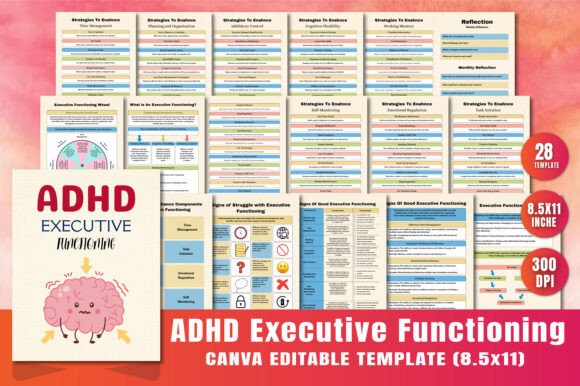
ADHD Executive Functioning
If you’ve ever struggled to start a task—even one you care about—or lost track of time while scrolling instead of working, you’re not lazy or unmotivated. You may be navigating challenges rooted in ADHD executive functioning: the brain’s built-in management system for planning, focus, self-regulation, working memory, and flexible thinking. Unlike general productivity advice, ADHD executive functioning isn’t about “trying harder.” It’s about understanding how your neurology shapes real-world behavior—and designing supports that align with it.
Many adults discover ADHD later in life—often after years of misattribution: calling themselves “disorganized,” “forgetful,” or “bad at follow-through.” But these aren’t character flaws. They’re signals that core executive functions—like initiating action, holding multiple steps in mind, or shifting attention smoothly—are operating differently. That insight changes everything. It shifts the focus from fixing *you* to refining *your environment*, tools, and routines.
Common Missteps When Addressing ADHD Executive Functioning
Well-meaning efforts often backfire—not because the intention is wrong, but because the approach ignores neurodivergent reality. Here are three frequent, costly oversights:
- Assuming universal strategies work equally well. A color-coded planner might energize one person and overwhelm another. For many with ADHD, visual clutter competes for attention, making complex layouts counterproductive—not helpful. Similarly, rigid time-blocking fails when internal time perception is inconsistent (a common trait in ADHD executive functioning). What looks like “structure” can feel like constraint.
- Treating autism executive functioning and ADHD executive functioning as interchangeable. While both neurotypes often experience executive function differences, the patterns differ meaningfully. Someone with autism may struggle more with cognitive flexibility (e.g., adapting to unexpected changes) or sensory-related task initiation, whereas someone with ADHD may face greater difficulty with sustained attention during low-stimulation tasks—even if deeply interested. Blending the two without nuance leads to mismatched tools and frustration.
- Overlooking the role of energy, not just time. Many resources emphasize scheduling—but ignore that executive function relies heavily on available mental and physical energy. A strategy that works at 9 a.m. may collapse by 3 p.m. due to depletion. Ignoring this leads to self-criticism (“I failed again”) instead of adjusting support based on rhythm, rest, and regulation needs.
These mistakes don’t just waste time—they erode confidence. When a beautifully designed journal sits unused, or a downloaded template feels alienating rather than supportive, it reinforces the false idea that *you’re* the problem—not the fit between tool and neurology.
Better Approaches: Practical, Neuro-Informed Choices
Start with alignment—not aesthetics. Before downloading or buying anything labeled “executive functioning,” ask: Does this honor how my brain actually starts, sustains, and switches tasks?
For example, instead of a 40-page undated planner filled with daily gratitude prompts and habit trackers (which demand consistent initiation and reflection), a focused, minimalist 16-page guide—like the Strategies To Enhance interior—offers clarity without overload. Its clean layout, intentional spacing, and targeted sections (e.g., “Signs of Struggle with Executive Functioning,” “Reflection Notes”) invite engagement—not avoidance. And because it’s built for customization in Canva, you’re not stuck with someone else’s assumptions. You choose fonts, colors, emphasis, and even reorder pages to match your workflow.
This matters because executive functioning isn’t static—it’s situational. A freelancer juggling client deadlines needs different scaffolding than an educator managing classroom transitions. A print-ready 8.5 x 11″ PDF at 300 DPI ensures crisp results whether you’re printing one page for a therapy session or binding a full workbook. JPG and PNG options let you embed visuals directly into digital planners or share snippets with accountability partners—no design expertise required.
What to Check Before You Commit
Before using any resource—digital or printed—scan for these practical markers:
- Is it editable *in practice*, not just in theory? Some templates claim “customizable” but lock layers or use proprietary fonts. The Canva-based version here opens instantly, lets you change text, resize elements, swap icons, and adjust spacing—all within minutes.
- Does it separate explanation from action? Understanding what executive functioning is (covered in the 2-page “What Is An Executive Functioning” section) builds self-awareness. But real progress happens in the “Strategies To Enhance Components of Executive Functioning” pages—where theory meets doable, bite-sized actions.
- Does it include space for reflection—not just tracking? Growth isn’t linear. The dedicated “Reflection Notes” pages help you notice patterns: *When did I actually follow through? What made that possible?* That insight—not perfection—is what builds sustainable skill.
Also consider usability across contexts. If you rely on screen readers, check contrast and alt-text readiness (the high-contrast, clean typography here supports accessibility). If you print often, verify file resolution—300 DPI means no blurry text or pixelated diagrams. And if you collaborate (with therapists, coaches, or support groups), having both PDF and PNG versions means you can share editable links or static handouts—without compatibility headaches.
Why This Design Works—Without Overpromising
This isn’t a “cure-all” workbook. It doesn’t promise overnight transformation. Instead, it offers something rarer: neurological respect built into the format. The Executive Functioning Wheel—a visual anchor across two pages—helps map strengths and friction points without judgment. The “Signs Of Good Executive Functioning” section gently reframes success: completing one step counts. Pausing to reset is skill-building—not failure. That subtle language shift alone reduces shame, which is half the battle.
And because it includes 28 professionally designed templates—not just one—it adapts as your needs evolve. Today you might need a simple task-initiation prompt. Next month, a sensory-regulation checklist. Later, a meeting-prep sheet for job interviews. All built on the same foundation: clarity, flexibility, and dignity.
Ultimately, supporting ADHD executive functioning isn’t about forcing yourself into neurotypical molds. It’s about choosing tools that act as extensions of your thinking—not obstacles to it. Whether you're a creator launching your first course, an entrepreneur streamlining operations, or someone simply reclaiming calm in daily life, the right foundation makes all the difference. Not in how much you produce—but in how sustainably, kindly, and authentically you show up for yourself.