Challenging Negative Thoughts CBT
What if your most persistent inner critic wasn’t truth—but habit? CHALLENGING NEGATIVE THOUGHTS CBT is a grounded, evidence-based method for recognizing, questioning, and reshaping unhelpful thinking patterns. Rooted in cognitive behavioral therapy (CBT), it doesn’t ask you to “think positive” on command. Instead, it invites curiosity: What evidence supports this thought? What evidence contradicts it? Is there another way to interpret this situation? That shift—from automatic reaction to intentional inquiry—is where real mental flexibility begins.
This isn’t abstract theory. It’s a practical toolkit used by therapists, educators, coaches, and self-guided learners worldwide. And because its core process is structured yet adaptable, it translates powerfully into creative, print-ready resources—like the high-quality KDP interior template described here. Designed for clarity and usability, it transforms clinical technique into accessible, actionable pages you can hold, write on, and personalize.
Why Structure Matters More Than Perfection
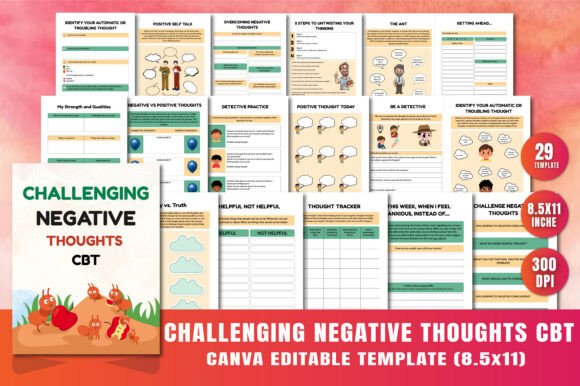
CHALLENGING NEGATIVE THOUGHTS CBT works best when applied consistently—not perfectly. That’s why templates like this one include guided prompts such as “Identify Your Automatic or Troubling Thought” and “Be a Detective: Positive Thought Today”. These aren’t fill-in-the-blank exercises; they’re scaffolds that reduce decision fatigue and build momentum. For example, the Thought Tracker helps users notice timing, triggers, and intensity—revealing patterns that might otherwise stay invisible. The Anxiety vs. Truth chart gently separates emotional sensation from factual reality, a distinction many struggle with during stress or uncertainty.
Designers and publishers appreciate how these layouts balance white space, visual hierarchy, and functional typography. Each page serves a distinct purpose—no redundancy, no clutter. Whether someone uses it for daily journaling, clinical homework, or classroom reflection, the structure holds steady while the content stays deeply personal.
Creative Applications Across Audiences
This template isn’t just for therapists or people in active therapy. Its versatility makes it valuable across roles:
- Freelancers & entrepreneurs use the “When I Feel Anxious, Instead of…” page to reframe imposter thoughts before client calls or pitch meetings.
- Educators adapt the “My Strength and Qualities” spread into student self-reflection tools—building resilience alongside academic skills.
- Bloggers and content creators extract individual worksheets (e.g., Negative vs. Positive Thoughts) to offer as lead magnets—valuable, branded, and clinically sound.
- Hobbyists and journalers combine the Positive Self-Talk Log and Thought Record Chart into a hybrid gratitude-and-cognition practice—tracking both what they say to themselves and how it lands.
Even small business owners repurpose sections for team wellness initiatives: printing the “Coping With Trauma” spread (adapted sensitively) for employee resource groups, or using the “Looking Back / Looking Forward” layout in quarterly check-ins to assess progress beyond metrics.
Customization That Serves Purpose—Not Just Aesthetics
The editable Canva template gives full control—but smart customization starts with intention. Before changing colors or fonts, ask: Who is using this, and what do they need to feel supported—not distracted?
A therapist might keep the layout clean and clinical, adding only their logo and contact info. A wellness coach could soften tones and integrate gentle icons to signal safety and approachability. A publisher building a workbook series might standardize headers and margins across multiple titles—ensuring brand cohesion without sacrificing usability.
Because all 29 templates are sized at 8.5 x 11 inches and rendered at 300 DPI, every version prints crisply—whether bound into a spiral notebook, assembled as a PDF download, or printed in bulk for workshops. No scaling, no pixelation, no guesswork.
Real Examples, Real Impact
Consider Maria, a freelance graphic designer in her late 30s. She started using the ANT (Automatic Negative Thoughts) tracker after noticing recurring thoughts like *“My portfolio isn’t good enough for serious clients.”* Over two weeks, she logged each occurrence—and discovered 70% happened after scrolling social media, not after actual client feedback. That insight shifted her focus from self-judgment to boundary-setting: she reduced passive scrolling and added five minutes of affirming review (“Here’s what I did well today”) before opening email.
Or James, a high school history teacher who adapted the “5 Steps to Untwisting Your Thinking” into a 15-minute classroom activity. Students analyzed historical figures’ decisions through a CBT lens—asking, *“What assumptions might they have held? What evidence did they ignore?”* The exercise built critical thinking while modeling emotional awareness.
Keeping It Clear, Consistent, and Human
Effective CHALLENGING NEGATIVE THOUGHTS CBT resources avoid jargon and forced positivity. This template does that by naming thoughts plainly (*“I’m going to fail”*), inviting gentle challenge (*“What’s the evidence for and against that?”*), and leaving room for nuance (*“Sometimes this feels true—and sometimes it doesn’t”*).
To maintain consistency across uses: stick to one primary font pair, limit color accents to two or three, and always preserve sufficient line spacing. When editing in Canva, use the built-in alignment guides and master page features—so headers, margins, and bullet styles stay uniform, even when rearranging pages.
Originality comes not from reinventing the framework, but from how authentically it’s applied. A handwritten note in the “My Notes” section carries more weight than a polished quote. A scribbled revision in the “Final Thought” box shows growth far better than a perfect sentence.
Getting Started—Without Overcomplicating
You don’t need to launch a full workbook to benefit from this system. Start small:
- Print just the Thought Record Chart and use it for three days.
- Try the “Be a Detective” prompt each morning—writing one observation about a recent thought without judgment.
- Share the “Helpful vs. Not Helpful” page with a colleague or friend as a low-pressure conversation starter about mental habits.
Each use builds familiarity—not just with CHALLENGING NEGATIVE THOUGHTS CBT, but with your own mind’s rhythms. And because the template is fully editable and print-ready, your next step is always one click away: refine, reframe, and put it into practice—exactly as you need it.