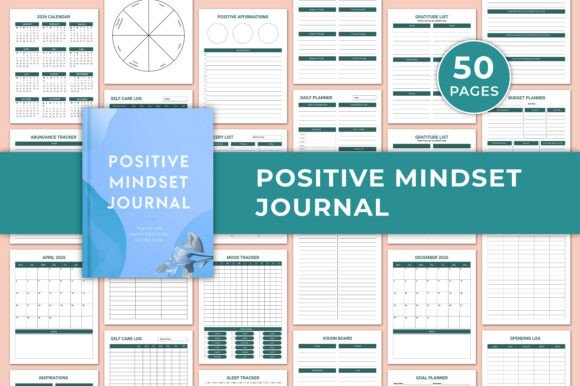
Positive Mindset Journal KDP Interior
A well-designed journal interior isn’t just about aesthetics—it’s the functional backbone of any successful self-publishing project. The Positive Mindset Journal KDP Interior stands out not because it’s flashy, but because it’s built with intention: a 50-page, US Letter–sized, fully editable Canva template optimized for Kindle Direct Publishing and print-on-demand workflows. It’s designed for creators who understand that consistency, clarity, and customization are non-negotiable when launching a journal meant to support real behavioral habits—not just fill shelf space.
What This Template Actually Delivers
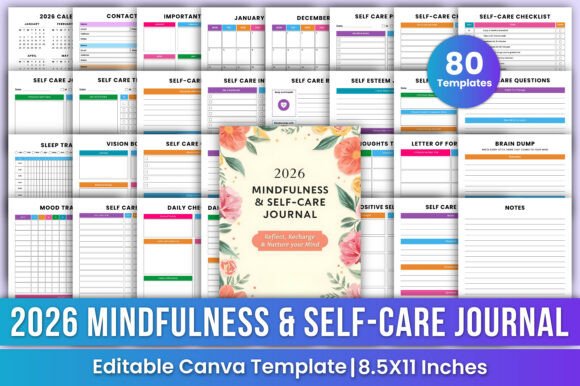
This isn’t a static PDF you stamp your logo onto and call done. The Positive Mindset Journal KDP Interior arrives as a layered Canva file—meaning fonts, colors, spacing, icons, and layout blocks can be adjusted without design expertise. Every page is structured with clear visual hierarchy and purpose-driven content zones: headers, input fields, checkboxes, trackers, and blank spaces sized to accommodate handwriting or light digital annotation. The 50-page count includes thoughtful redundancies (e.g., two medication logs, two self-care logs) not as filler, but to reflect how users actually engage—repeating tools across months or contexts increases retention and reduces friction.
The inclusion of a 2026 calendar and monthly planners (January through December) signals attention to timeliness and usability. Unlike generic templates that rely on placeholder dates, this one anchors planning in a specific year—helping creators avoid last-minute date updates before launch. Holiday names are pre-populated per U.S. federal observances, saving time for U.S.-based publishers while remaining easy to edit for international audiences.
Functional Design That Supports Real Behavior Change
Tracking tools like the abundance tracker, life balance wheel, mood tracker, and gratitude list aren’t decorative. They’re scaffolded with consistent formatting: uniform checkbox sizing, standardized date fields, and intuitive labeling. For example, the “Reframe My Thoughts” spread pairs a negative thought prompt with dedicated lines for alternative phrasing—encouraging cognitive flexibility without requiring users to interpret instructions. Similarly, the “My Manifestation” and “Vision Board” pages separate ideation (blank canvas) from execution (structured prompts), acknowledging that inspiration and implementation require different mental modes.
The budget planner and spending log use simple column-based layouts—not complex spreadsheets—making them accessible to users who want awareness, not accounting rigor. Likewise, the grocery list and to-do list avoid over-engineering: clean lines, ample writing space, and logical grouping (e.g., categories like “Produce,” “Pantry,” “Frozen”) reduce decision fatigue during daily use.
Practical Usability for Creators and End Users
Because it’s built for Canva, the Positive Mindset Journal KDP Interior lowers the barrier to professional-grade customization. You don’t need Adobe InDesign or Illustrator to adjust branding—just a free Canva account and basic familiarity with drag-and-drop editing. Fonts can be swapped globally; color palettes updated via theme settings; and layout proportions fine-tuned using pixel-accurate guides. The high-resolution JPG and PNG exports ensure sharp printing—even at 300 DPI—without bleeding into margins, which matters for KDP’s strict trim requirements.
That said, there are realistic constraints. The template doesn’t include interactive elements (e.g., clickable hyperlinks or form fields), nor does it support automatic date population—so recurring tasks or dynamic calendars still require manual entry. Also, while the structure supports handwriting, extremely dense layouts (e.g., the dual-column “Important Notes” + “Notes” spread) may feel cramped for users with larger handwriting or those printing on lower-quality paper.
Who Benefits Most—and When
This interior works best for creators building journals aimed at habit formation, emotional regulation, or lifestyle alignment—not abstract reflection. Coaches, therapists, wellness educators, and mindfulness course creators often use it as a companion to programs where consistency matters more than novelty. Freelance designers and indie publishers also adopt it when launching multiple journal variants: swapping affirmations, adjusting tracker frequency, or localizing holidays takes minutes—not days.
Professionals aged 30–45 who manage complex personal and work responsibilities tend to respond well to its balanced scope: enough structure to build routine, but enough white space to avoid overwhelm. A small business owner tracking quarterly goals alongside self-care metrics, for instance, benefits from having both the goal planner and life balance wheel on adjacent pages—allowing side-by-side review. Similarly, someone managing chronic health conditions finds value in the dual medication log and self-care log, especially when used together to spot patterns between treatment adherence and energy levels.
Quality, Consistency, and Long-Term Fit
Print quality is reliable: all text is vector-based in Canva (no rasterized type), and line weights remain crisp at standard print sizes. Margins align cleanly with KDP’s 0.25-inch minimum, and no elements sit too close to trim edges. Page numbering is absent by design—a deliberate choice, since many journal users prefer unnumbered spreads to maintain flexibility in how they navigate or bind pages.
Consistency is maintained through repetition of core visual cues: same bullet style across lists, uniform checkbox size (14×14 px), and consistent font hierarchy (headers in bold sans-serif, prompts in regular weight, inputs in light gray). That predictability builds user confidence—especially important for habit-tracking tools where cognitive load must stay low.
Long-term, the value lies in adaptability. As audience needs shift—say, adding seasonal gratitude prompts or integrating new therapeutic frameworks—the template allows iterative updates without rebuilding from scratch. One educator repurposed the vision board page into a “Classroom Values Map” for student-led goal setting; another creator merged the abundance tracker with income categories to build a “Values-Aligned Income Log.” These adaptations succeeded because the underlying structure was stable, not rigid.
Realistic Considerations Before You Use It
If your project requires multilingual support, note that text boxes are editable—but non-Latin scripts may need manual font substitution outside Canva’s default library. Also, while the template includes a blank vision board, it doesn’t embed drag-and-drop image upload functionality; users must insert images manually in Canva or after export. And although the file exports cleanly to PDF, heavy use of transparency or gradient overlays may affect KDP’s color rendering—best tested with a physical proof copy.
Finally, consider audience expectations. Readers purchasing a “positive mindset” journal often seek warmth and approachability. The current design leans clean and modern—effective for professionals—but may feel too minimal for audiences drawn to illustrated, story-driven, or highly tactile journal experiences. Pairing it with custom cover art, hand-drawn dividers, or supplemental printable stickers helps bridge that gap.
The Positive Mindset Journal KDP Interior earns its place not by trying to do everything, but by doing a focused set of things well: supporting reflection, enabling action, and adapting to real-world usage patterns—all within a production-ready framework. It’s a tool that respects both the creator’s time and the user’s attention span.